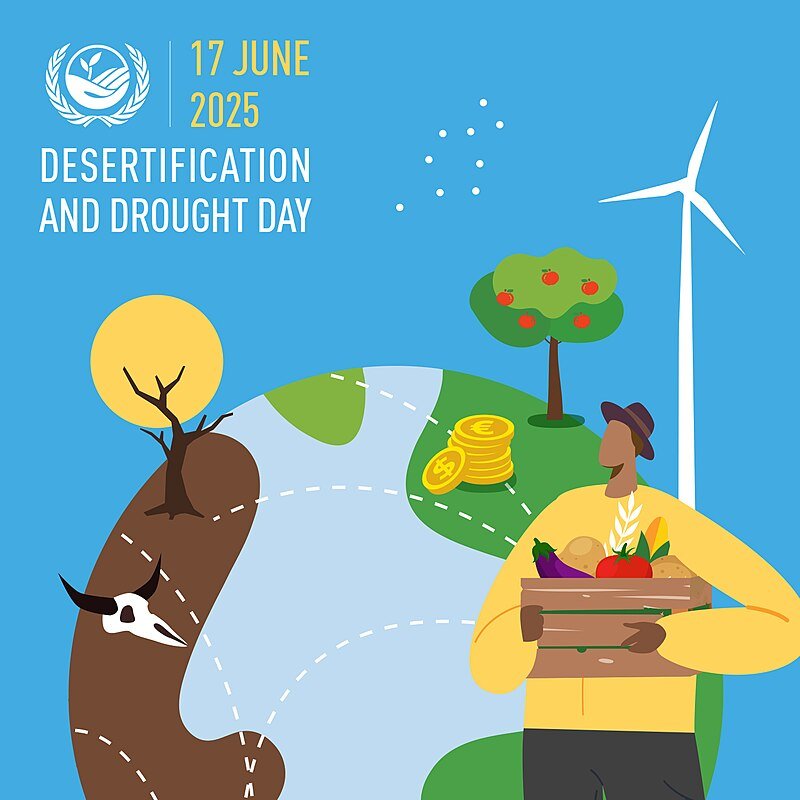
World Day to Combat Desertification and Drought
Desertification and Drought Day was officially declared by the UN General Assembly as “World Day to Combat Desertification and Drought”.
We have the power to bring land back to life. A restored land is a land of endless opportunities. It’s time to unlock them now. In 2025, Desertification and Drought Day focuses on one of the most urgent global challenges: restoring 1.5 billion hectares of degraded land and jumpstarting a trillion-dollar land restoration economy by 2030. Under the theme “Restore the land. Unlock the opportunities,” the 2025 observance shines a light on how restoring nature’s foundation—land—can create jobs, boost food and water security, support climate action, and build economic resilience.
ESG as a Framework for Resilience: India’s Battle Against Desertification and Drought
Desertification and drought are not just environmental issues — they’re deeply intertwined with livelihoods, food security, and economic stability. In India, where over 30% of land is already degraded, the stakes are high. But ESG offers a powerful lens to tackle this crisis holistically. The theme of the event was “Strategies for Combating Desertification and Drought”, focusing on sustainable land management in arid and semi-arid ecosystems.
In line with India’s commitment to the UN Convention to Combat Desertification, the government has adopted a comprehensive approach focusing on ecosystem restoration, drought resilience, and biodiversity enhancement.
- Amrit Sarovar’s: Aiming to rejuvenate water bodies to combat desertification and support biodiversity.
- Matri Van: Encouraging communities, especially in the Aravalli region, to plant trees in the name of their mothers, fostering a deep connection with nature.
- Ek Ped Maa Ke Naam: A nationwide movement initiated by Prime Minister, where citizens plant trees in honour of their mothers, symbolizing respect for ‘Mother Earth’
Environmental: Healing the Land with Innovation
The “E” in ESG is front and centre in combating land degradation:
- Satellite-Based Monitoring: India’s use of ISRO’s remote sensing and drought vulnerability mapping allows for early warning systems and targeted interventions.
- Soil Health Management: The Soil Health Card Scheme has empowered millions of farmers with data-driven insights, reducing overuse of fertilizers and improving soil fertility — a key to preventing desertification.
- Afforestation and Carbon Sinks: India’s commitment to the Bonn Challenge restoring 26 million hectares of degraded land by 2030 is already over 85% fulfilled. These efforts also contribute to carbon sequestration, aligning with climate goals.
- Water Conservation Models: Initiatives like Jal Shakti Abhiyan and watershed development in drought-prone regions have rejuvenated ecosystems and improved groundwater recharge.
Social: Empowering Communities, Building Resilience
The “S” in ESG ensures that solutions are inclusive and equitable:
- Community-Led Restoration: Programs like the Green India Mission involve local communities in afforestation and land restoration, creating green jobs and fostering ownership.
- Women in Land Stewardship: In states like Rajasthan and Madhya Pradesh, women’s self-help groups are leading micro-irrigation and organic farming initiatives, enhancing both land health and gender equity.
- Climate-Resilient Agriculture: Promotion of millets, agroforestry, and organic clusters in states like Sikkim and Andhra Pradesh reduces water dependency and improves soil resilience.
Governance: Policy, Accountability, and Global Leadership
The “G” in ESG ensures transparency, accountability, and long-term vision:
- Centre of Excellence on Sustainable Land Management: India has established this hub to promote science-backed restoration, capacity building, and international collaboration.
- Sustainability Reporting: SEBI’s BRSR (Business Responsibility and Sustainability Reporting) framework mandates ESG disclosures, pushing companies to align with national sustainability goals.
- Public-Private Partnerships: From CSR-funded afforestation to ESG-aligned investment in water infrastructure, governance is enabling multi-stakeholder collaboration.
- International Leadership: At COP16 of the UNCCD, India showcased its proactive strategies, emphasizing prevention over reaction, and offered its expertise to other nations.
Why ESG Matters
Without ESG, efforts to combat desertification risk being fragmented and short-lived. ESG ensures:
- Environmental integrity through sustainable land and water use.
- Social justice by empowering vulnerable communities.
- Governance accountability to track progress and scale impact.
India’s journey is a powerful example of how ESG isn’t just a corporate buzzword it’s a national strategy for survival and sustainability.